
Seon-gyu Jeong
Oct. 14. 2025
Today, when AI automation has influenced international industry-sharing structure, both developing and advanced countries are looking for ways to develop their industries which need to be modified to fit with the environment of future AI.
As developing nations in Southeast Asia foster a second industry that has already developed, they have become one of the factories of the world. However, as new technologies like digital technology and AI have been developed, the UN has held meetings to prevent future inequality. First of all, let’s check southeast Asia.
Southern Asia: the world factory
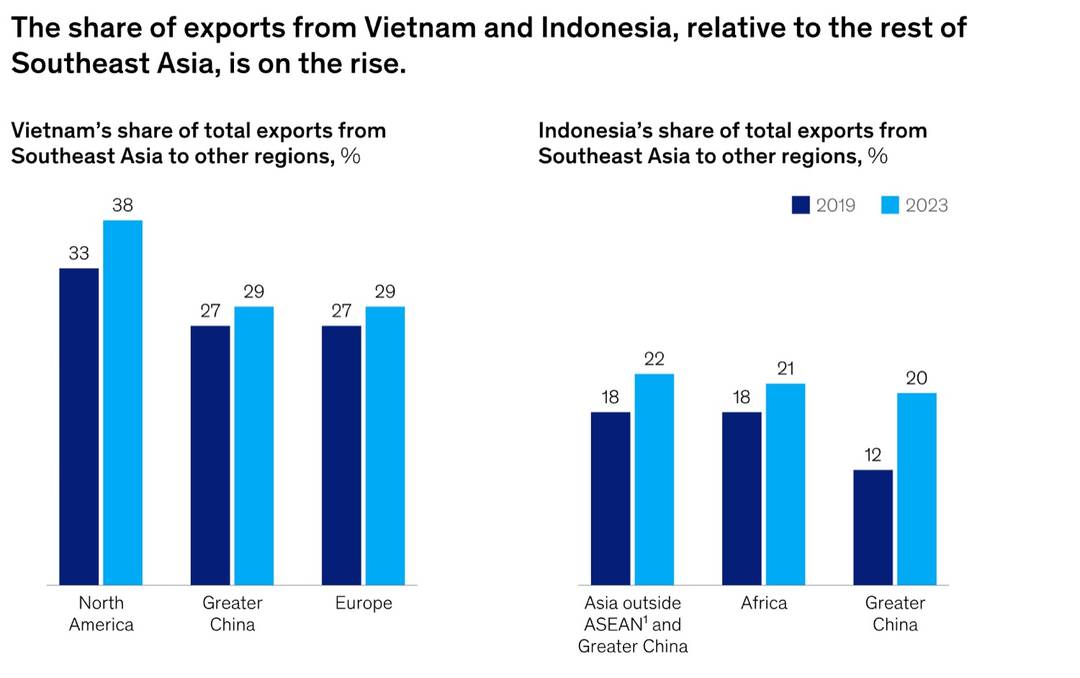
Recently, Southeast Asia has become popular as a global manufacturing hub for foreign investors. In 2023, Indonesia had raised investment of around 180 billion in 2019 to 16 billion and recorded 320 billion in 2019 to $440 billion in 2023, achieving a CAGR of 8.2 percent. As a result of these trends, in 2024, IIP of Southeast Asia expanded by 8.4%. Both countries got investments through FDI (Foreign Direct Investment). How were those kinds of growth possible? Here are some basic factors to check.
Diversifying of supply source / Regulation of Factory and High Wage in Developing Countries / Flying Geese Model
The Flying Geese Model, which explains the rapid manufacturing growth of Korea, Singapore, and Taiwan, describes how late-developing countries such as South Korea, Singapore, and Taiwan were able to progress their industries as they followed the industrial structure of advanced countries; Japan went ahead first, just as a flock of geese flies in a V-shape. Now Vietnam and Indonesia have become the next geese that follow Korea in the late 1970s Korea.
Their strategies include an abundant labor force and low wages. About 60% of workers in Vietnam's FDI industry are aged 15-34, and in 2024, Vietnam laborers' average monthly wage is about 1,503(40 hours a week). Also, Vietnam’s low environmental regulation builds a synergy in manufacturing.
These features made up the structure of the global industry. Low-income countries mainly earn money from primary industries like agriculture, fisheries, and mining. Middle-income countries develop manufacturing. More than 70 per-cent of European countries' GDP comes from the service industry.
New Opportunity or Threatening?

AI-related unemployment has become a global concern. According to TechCrunch’s report, unemployment among recent computer engineering graduates in the US reached 6.1% to 7.5% which is more than double that of graduates in biology or art history. Samsung also announced a new semiconductor factory, which will operate fully autonomously. These issues shocked people and have made a change in stereotypes about high-wage jobs. According to the IMF, about 60% of jobs in developed countries and 40% in developing countries are at risk of automation through AI. While AI technology innovation threatens traditional industries, can it be possible to make it an opportunity for developing countries?
According to Modern Diplomacy’s report, in Southeast Asia, about 9 million jobs will be replaced by AI, but around 11 million new jobs will be created. However, because many of the 83 million jobs projected to disappear globally include numerous manufacturing jobs which are concentrated in developing countries, there is an urgent need to create a new employment ecosystem. New AI-related jobs will be more advantageous in a strong digital access environment. As 27% of people use the internet among low-income countries, the digital divide is likely to widen the gap between low-income and high-income countries.
In this situation, the UN recently held a meeting on digital infrastructure in low-income countries, and leaders presented their proposals to reduce inequality.